The Rooster Crows Restoration
[Artwork Note: This drawing started as as experiment in textures. I got the look I wanted in the rooster's comb and wattle (beneath chin) by holding the drawing against a blown-in textured wall while shading these areas. Written 2007]
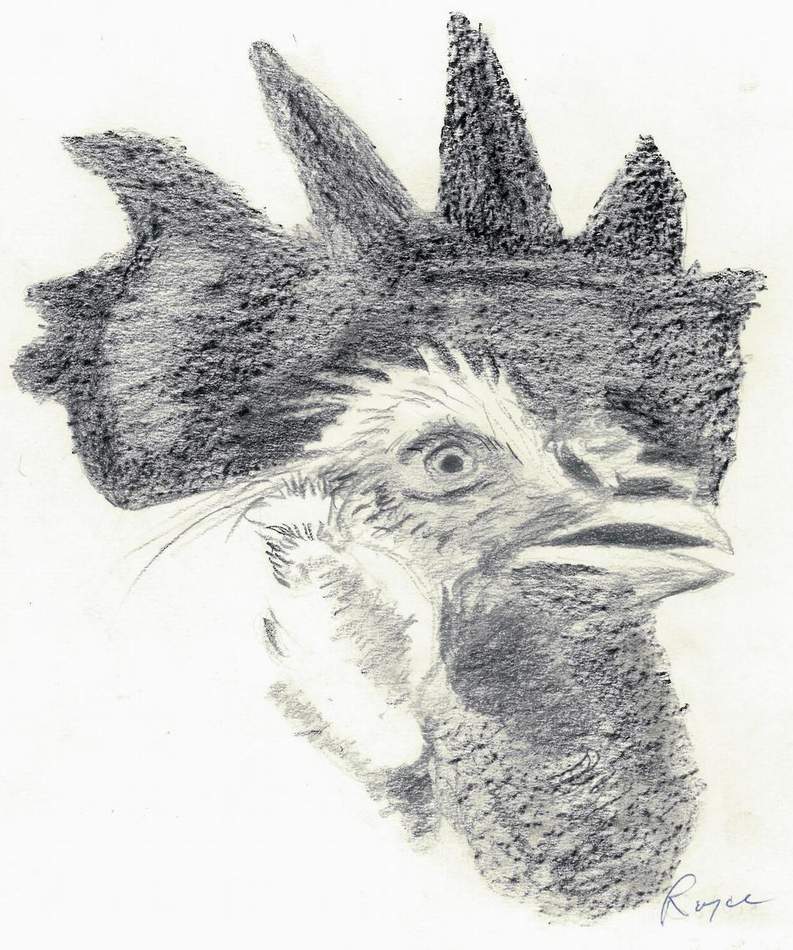 I believe that, at one time or another, almost all of us have
reached a low point in our spiritual life, possibly to the point
of questioning whether we have sunk so low that God can neither save
us or restore us to his fellowship. We've messed up before,
but this time we've really blown it big time. Our life has
imploded into a pile of rubble.
I believe that, at one time or another, almost all of us have
reached a low point in our spiritual life, possibly to the point
of questioning whether we have sunk so low that God can neither save
us or restore us to his fellowship. We've messed up before,
but this time we've really blown it big time. Our life has
imploded into a pile of rubble.
I'd like to tell you a story of such a person, and how God restored him, and can restore us, no matter how bad our collapse. I heard many sermons from pastors about how. after we sin, God makes plans to forgive and restore us the moment we ask, or even before we ask. In this story, we'll see a plan of restoration laid even before the sin has been committed.
The Collapse
Jerusalem ~30AD, immediately following the arrest of Jesus:
Then seizing him, they led him away and took him into the house of the high priest. Peter followed at a distance. But when they had kindled a fire in the middle of the courtyard and had sat down together, Peter sat down with them. A servant girl saw him seated there in the firelight. She looked closely at him and said, "This man was with him." But he denied it. "Woman, I don't know him," he said.
A little later someone else saw him and said, "You also are one of them." "Man, I am not!" Peter replied.
About an hour later another asserted, "Certainly this fellow was with him, for he is a Galilean."
Peter replied, "Man, I don't know what you're talking about!" Just as he was speaking, the rooster crowed. The Lord turned and looked straight at Peter. Then Peter remembered the word the Lord had spoken to him: "Before the rooster crows today, you will disown me three times." And he went outside and wept bitterly. (Luke 22:54-62)
Most of you are probably familiar with this story of the Apostle Peter who, after walking with Jesus for three years, listening to the teachings, and witnessing the miracles, publicly denied the Savior three times. Peter was undoubtedly the most self-confident of the apostles, without a tentative or shy bone in his body. Just hours before, Jesus had told the apostles that they would all fall away and be scattered. Peter's reply was that "Even if all fall away on account of you, I never will". "I tell you the truth," Jesus answered, "this very night, before the rooster crows, you will disown me three times." But Peter declared, "Even if I have to die with you, I will never disown you." (Mt 26:33-35).
We then see the rest of the story in Luke 22 above. Before we get to the restoration, let's ask the question, "why did Peter fail?" There was certainly nothing wrong with his intentions, but his confidence was misplaced. He overestimated his own strength and courage, and underestimated the weakness of his flesh (self). He placed his confidence in himself rather than in God.
Another related reason for his collapse was that he failed to pray. Remember a few hours before, when Jesus took Peter (along with James and John) into the garden with him and asked them to "pray that they would not fall into temptation". While Jesus was praying, Peter and the other two kept falling asleep. I would image that if a wanderer came upon them, saw Jesus anguishing in prayer, sweating drops of blood, while the apostles slept peacefully, he would probably think that Jesus was the weak one and that the others had it all together; however, when the moment of crisis came, Jesus calmly faced it while the other fell apart. Praying can often be hard work than, but not as difficult as the consequences resulting from lack of prayer.
The Rooster - Restoration Begins
So now we see Peter at the lowest point of his life. He's feeling like his world has collapsed around him and that he is unworthy of being restored to any kind of fellowship with Christ. The truth is, we are all unworthy, but God is faithful. The Scriptures are full of cases where God responds to prayers for forgiveness or cries for help (Daniel 10 is a great example).
In Peter's case, I think we receive a couple of glimpses of the plan of restoration even before his moment of failure. (In a real sense, we could say the plan was in place before time began, but we're speaking experientially here of when the plan is revealed). We first observe Jesus' statement to Peter (also called Simon) that we find back in Luke 22 just prior to his denial: "Simon, Simon, Satan has asked to sift you as wheat. But I have prayed for you, Simon, that your faith may not fail. And when you have turned back, strengthen your brothers" (v31-32).
I believe the second hint regarding Peter's future restoration is the rooster itself. Why did Jesus prophesize a rooster crowing rather than some other animal or event? I think it was because of what the crowing of a rooster signifies - the dawning of a new day. Peter was to receive a brand new day, with brand new opportunities.
I have been deprived of peace; I have forgotten what prosperity is. So I say, "My splendor is gone and all that I had hoped from the LORD." I remember my affliction and my wandering, the bitterness and the gall. I well remember them, and my soul is downcast within me. Yet this I call to mind and therefore I have hope: Because of the LORD's great love we are not consumed, for his compassions never fail. They are new every morning; great is your faithfulness. (Lam 3:17-23)
The Restoration - Peter's New Day
We now move forward to Peter's new day, a few weeks after the resurrection of Jesus. Peter and others were out on a boat. Peter was still down, figuring he'd blown it with God, so he might as well go back to fishing. You can read the full story in the last chapter of John (Ch 21), so I'll just summarize.
The men had fished all night and caught nothing. Jesus appeared and called out from the shore, instructing them to cast the net on the other side of the boat. When they did, they hauled in a big mess of fish. Now John, having a good memory (a similar incident previously occurred - see Luke 5), said to Peter, "It is the Lord". Peter jumped out of the boat and swam to shore.
After eating breakfast, Jesus begins Peter's restoration. Since Peter had denied Jesus three times, Jesus gives him three opportunities to confirm his loyalty by asking Peter "Do you love Me?". During this exchange, two different Greek words for "love" are used, agapas and philo. Agapas (verb form of the noun agape), is the kind of love that comes from God, sacrificial, and seeking the best for others rather than ourselves. Philo or Phileis (both verb forms of the noun Phileo), refer to a "brotherly love" or good friendship. In order to fully understand this conversation, we need to supplement the English translation with these Greek words.
When they had finished eating, Jesus said to Simon Peter, "Simon son of John, do you truly love [agapas] me more than these [disciples]?" "Yes, Lord," he said, "you know that I love [philo] you." Jesus said, "Feed my lambs" (Jn 21:15). Jesus asks Peter if he loves Him with a supreme love and Peter basically replies "Yes Lord, I like you. This is the same Peter who said weeks before that "These other guys may run out on you, but not me". Peter did not love Jesus any less than before, but now reality had set in, and he realizes that a person cannot produce an agape type love under his own power.
Again Jesus said, "Simon son of John, do you truly love [agapas] me?" He answered, "Yes, Lord, you know that I love [philo] you." Jesus said, "Take care of my sheep" (Jn 21:15). Jesus drops the "more than these" phrase and just asks if Peter loves Him.
The third time he said to him, "Simon son of John, do you love [phileis] me?" Peter was hurt because Jesus asked him the third time, "Do you love [phileis] me?" He said, "Lord, you know all things; you know that I love [philo] you." Jesus said, "Feed my sheep. (John 21:17)
I think we should notice a couple of things in the last verse. First, we see that Peter is still hurting and knows he can't come up to Jesus' standard of love, so Jesus came down to meet him where he was. When we cry out to God, He doesn't expect us to do anything beyond what he has equipped us to do, He will come down and meet us where we are. Second, by saying "Feed My sheep", Jesus is inviting Peter back into the ministry, and will do the same for us if we earnestly ask.
The Rest of the Story
For those unfamiliar with Peter and wondering whether he was actually restored (and then some), all one has to do is read the 2nd thru the 5th chapters of Acts. Here we see Peter preaching a sermon on the Day of Pentecost which brought three thousand people to faith in Christ. Then, standing before the Jewish authorities who had ordered the apostles to stop preaching in the name of Christ, the same Peter, who weeks before cowered before a servant girl and denied the Lord, now boldly proclaimed "We must obey God rather than man" (Acts 5:30)! Then after being severely beaten, The apostles left the Sanhedrin, rejoicing because they had been counted worthy of suffering disgrace for the Name. Day after day, in the temple courts and from house to house, they never stopped teaching and proclaiming the good news that Jesus is the Christ (Acts 5:41-42).
Each of us has a different opportunity to serve God, but when we've blown it, we must first stop attempting to rebuild our own lives with our own strength. As the old saying goes, "If you find yourself in a hole, the first thing you should do is stop digging". When our world has collapsed around us, God knows better than us how to rebuild. Besides that, He also has much better tools.