Skull of Death What does the Bible Say about Alcohol and Drugs?
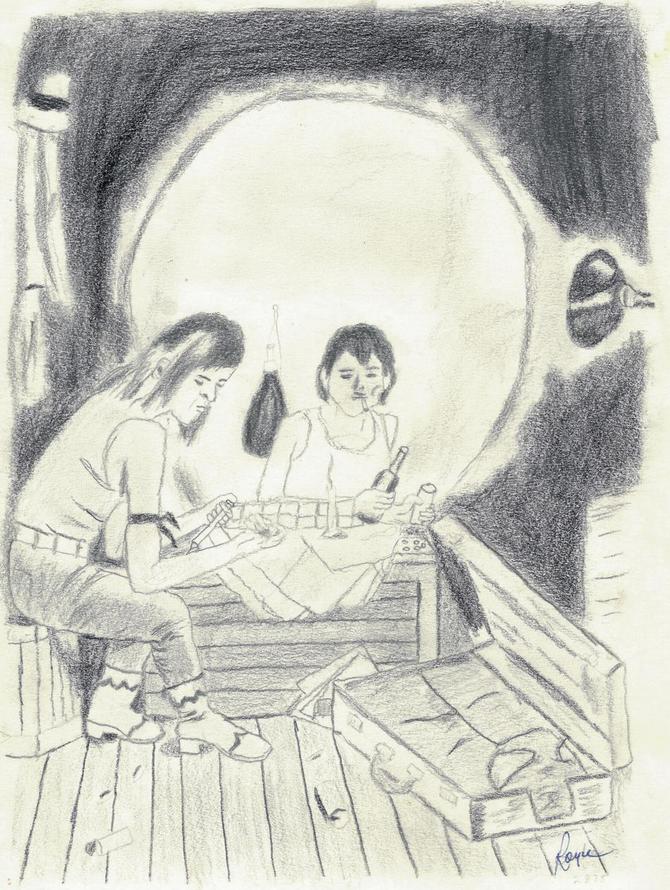
[Artwork Note: You might have to step back from the computer to get the full effect. The mirror forms a grinning skull, with the heads as the eyes and the hanging pouch as the nose. I think the idea came from an old magazine back in the late sixties or early seventies. Article written: Aug 2007.]
 In Northeast Texas, there is a 15 mile stretch of State Highway 37N between Clarksville, Texas and the Red
River (Oklahoma border) that is usually lined with several crosses.
It was a very popular spot for teenage drag racing since it
contained long straight sections of roadway. The majority of
land on either side was owned by timber companies and there were
many large trees within the right of way. As soon as you
passed over the river into Oklahoma, you encountered several liquor
stores (Red River County, Texas was dry), so one can easily see the
disasters that the combination of these conditions could bring.
In Northeast Texas, there is a 15 mile stretch of State Highway 37N between Clarksville, Texas and the Red
River (Oklahoma border) that is usually lined with several crosses.
It was a very popular spot for teenage drag racing since it
contained long straight sections of roadway. The majority of
land on either side was owned by timber companies and there were
many large trees within the right of way. As soon as you
passed over the river into Oklahoma, you encountered several liquor
stores (Red River County, Texas was dry), so one can easily see the
disasters that the combination of these conditions could bring.
I drew this in 1975 after receiving the news of losing yet another friend and former high school classmate, in an alcohol related accident, to a tree along this deadly stretch of road.
Whiskey bottles, and brand new cars
Oak tree you're in my way
There's too much coke and too much smoke
Look what's going on inside you
Ooooh that smell
Can't you smell that smell
Ooooh that smell
The smell of death surrounds you
Angel of darkness is upon you
Stuck a needle in your arm
So take another toke, have a blow for your nose
One more drink fool, will drown you
Ooooh that smell
Can't you smell that smell
Ooooh that smell
The smell of death surrounds you
Now they call you Prince Charming
Can't speak a word when you're full of 'ludes
Say you'll be all right come tomorrow
But tomorrow might not be here for you
(Excerpt from "That Smell" by Lynyrd Skynyrd - written by Allen Collins & Ronnie VanZant)
The Bible's View of Alcohol and Drugs
The Bible clearly prohibits the abuse of alcohol, but what does it have to say about drugs. We'll look at these topics separately.
Alcohol
Do not get drunk on wine, which leads to debauchery. Instead, be filled with the Spirit. (Eph 5:18)
Wine is a mocker and beer a brawler; whoever is led astray by them is not wise. (Prov 20:1)
So then, let us not be like others, who are asleep, but let us be alert and self-controlled. For those who sleep, sleep at night, and those who get drunk, get drunk at night. But since we belong to the day, let us be self-controlled, putting on faith and love as a breastplate, and the hope of salvation as a helmet. (1Thess 5:6-8)
You can check out a topical Bible for several dozen additional verses addressing the abuse of alcohol, all consistent with the above.
Drugs
While we can easily see that the Scriptures explicitly prohibits the abuse of alcohol, we don't find any command that says "Thou shalt not smoke pot" or "Abstain from snorting cocaine". I think we should be cautious when venturing beyond the literal meaning of scripture, however in this case, we'll find the Bible strongly implies this prohibition in several ways.
First, if we look at the nature of the direct commands (the infallible "do" and "do not"), the first thing we notice is that they are based upon the character of God, so we can ask ourselves if our actions are consistent with God's revelation of Himself thru the scriptures and thru His Son (Heb 1:1-2). Next, we see that the commands are not exhaustive, but paradigmatic, that is, they set a classical standard utilizing an example. Much like our own government's laws, it's not practical to address every possible scenario that might come up. We sometimes refer to this Bible interpretation principle as the "pattern of meaning". For instance, in Matthew 12, when the religious leaders condemn Jesus for healing a man on the Sabbath, Jesus replies "If any of you has a sheep and it falls into a pit on the Sabbath, will you not take hold of it and lift it out? How much more valuable is a man than a sheep! Therefore it is lawful to do good on the Sabbath" (v11-12). Now, Jesus declares that it's permissible to lift a sheep out of a pit on the Sabbath, but what if it was a goat or a donkey? Would we be forbidden to lend a hand? It is clear that Jesus is referring to "doing good on the Sabbath" and using the sheep as an example. So, we see that, although the Biblical commands (law) are limited in their letter (wording), they are actually very comprehensive in spirit. The books of Leviticus and Deuteronomy are loaded with additional examples.
Let's look at the spiritual meaning of one of the alcohol related verses. Do not get drunk on wine, which leads to debauchery. Instead, be filled with the Spirit (Eph 5:18). Now, since Paul only mentions wine here, does this mean it's acceptable for us to get drunk on whiskey? Of course not. The word "filled" means "controlled by", so the prohibition is against the effect of the alcohol, and the "pattern of meaning" is that a person should be under the control of the Holy Spirit rather than the substance. When we take drugs, we lose self control, a fruit of the Spirit according to Galatians 5:22 (see also 1Thess 5:6-8, 2Tim 1:7, Titus 2:1, 1Peter 1:13 & 4:7, and 2Peter 1:5-6). Studies have found that the average person will reach the legal blood alcohol content limit by consuming two beers in one hour. The impairment effect of smoking one marijuana joint is about the same as drinking three beers and a snort of cocaine equivalent to seven beers. Additional studies have found that, while the mind-altering effects of alcohol are usually temporary, the mind-altering traits of most drugs can permanently change a person's thinking, personality and beliefs. So, if the Bible prohibits abuse of alcohol due to a temporary loss of self-control, how much more for mind-altering drugs.
Don't you know that you yourselves are God's temple and that God's Spirit lives in you? If anyone destroys God's temple, God will destroy him; for God's temple is sacred, and you are that temple (1 Cor 3:16-17).
Finally, we should mention that the Bible strongly condemns sorcery and witchcraft in both the Old and New Testaments (Lev 19:6, Dt 18:10, 2Kings 17:17, Mic 5:12, Gal 5:20, 2Tim 3:13, Rev 9:21, 21:8, 22:15 etc). If you are wondering what this has to do with drugs, the Greek word which is translated sorcery or witchcraft is pharmakia, from which we derive the English word "pharmacy". According to W.E. Vine's Expository Dictionary of New Testament Words, the word "pharmakia" refers to "a sorcerer, especially one who uses drugs, potions, spells, enchantments." Vine goes on to state that "In sorcery, the use of drugs, whether simple or potent, was generally accompanied by incantations and appeals to occult powers, with the provision of various charms, amulets, etc, professedly designed to keep the applicant or patient from the attention and power of demons, but actually to impress the applicant with the mysterious resources and powers of the sorcerer."
A Way Out
I don't want to close this article without writing a few words for those who are addicted to drugs or alcohol. I'm not a trained counselor and have not abused alcohol or drugs, only by the Grace of God, not by any merit on my part, so I won't pretend to identify with your exact struggles. I do have many friends and relatives who have been caught up in this culture, so I've learned a lot from talking with them. The first thing I've noticed is the addict's feeling that they are empty, useless, unloved and unneeded. This is simply not true. You were "fearfully and wonderfully made" by God, and you are worth the sacrifice of His only Son for your redemption. When you're feeling down, remember who you are in Christ. If you're not a Christian, or not sure of your eternal destiny, please check out our How to Know for Sure that You're Going to Heaven. You don't have to wait until you kick the habit, you can do this now (Rom 5:8).
The struggle with alcohol and drugs has many things in common with endeavoring to overcome other habits and strongholds. Our number one ally is prayer. We must pray about everything. Next, we should surround ourselves with caring Christian friends who can encourage and lovingly hold us accountable for our actions. At some point, we may also need to seek advice from a good Christian counselor. Remember that Christians aren't perfect, just forgiven, and many have gone thru similar circumstances, and with the help of God, emerged victorious.
A Biblical Formula for Obedience to God's Word
I think all of us had some sort of stronghold, addition or idol which is contrary to God's Word, so let's conclude by looking at a few answers in scripture. First, we know that if we become and remain obedient to the Word of God (easier said than done), all our strongholds will disappear... but, how do we obtain obedience?
The Apostle Paul states that obedience comes from faith. Through him (Jesus) and for his name's sake, we received grace and apostleship to call people from among all the Gentiles to the obedience that comes from faith (Rom 1:5).
OK, so where do we get this faith? Again, Paul has the answer. Consequently, faith comes from hearing the message, and the message is heard through the word of Christ (Rom 10:17).
Therefore, we receive faith as a gift from God (Eph 2:8), by prayerfully reading the word of God, which leads to obedience (doing what the Word says).
Do not merely listen to the word, and so deceive yourselves. Do what it says. Anyone who listens to the word but does not do what it says is like a man who looks at his face in a mirror and, after looking at himself, goes away and immediately forgets what he looks like. But the man who looks intently into the perfect law that gives freedom, and continues to do this, not forgetting what he has heard, but doing it--he will be blessed in what he does (James 1:22-25).