Who was the Human Author of the NT Book of Hebrews?
A Commentary
This is a spinoff from our Solving Interpretive Challenges in the Book of Hebrews, a collection of articles examining a few of the most common interpretation difficulties and challenges that often puzzle readers of the book of Hebrews. In this article, we examine the evidence related to the human author of the book.
- Introduction
- Why the Author Matters
- The Cases For and Against Paul?
- Other Possible Authors
- Conclusion
Introduction
While we know that the divine author of the book is God Himself (2Tim 3:16-17), the human author is currently unknown. The author does not reveal his name in the text and we have no surviving exterior document that specifically names him or her. The author was probably a Christian preacher who was well known to his or her original audience at the time. He/she was very skilled skilled in the Greek and Hellenistic literary styles, taking the overwhelming majority of his OT quotations from the third or second century BC Septuagint (the Greek translation of the OT Hebrew). He/she was a Jew, evidenced by referring to “our ancestors” and “the prophets” (1:1). He/she was also acquainted with Timothy (13:23). While his/her name is currently unknown, there is no shortage of opinions, suggestions and guesses. In fact, this has been one of the most debated unknowns regarding the Bible from the early centuries AD.
We know the letter/epistle, or perhaps a homily (doctrinal lecture or sermon), was written prior to 70 AD, since internal evidence reveals that the Jerusalem Temple was still in use when letter was written (see Hebrews 9:1-10).
We first want to acknowledge that Origen’s famous second/third century AD statement that only God knows the human author of Hebrews is still true today. Thus, the primary purpose of this article is not to provide an indisputable answer to the the question that has been debated for two centuries. Instead, we hope to examine the internal and external evidence, arguments, and opinions that has been brought forward by Bible scholars over the years. We hope to evaluate the evidence and arguments, both for and against some of the most prominent and likely candidates.
We first begin with an explanation of why the identity of the author is of considerable importance.
Why the Author Matters
The identity of the author was extremely critical when it came to considering whether or not a book being included in the New Testament canon. In fact, the single most important “test” when considering a book for inclusion was that it had to be written by an apostle or close associate. The great 16th century reformer, Martin Luther initially questioned whether or not to include Hebrews in his German translation of the Bible. So, why did the early church fathers so overwhelmingly include Hebrews as the only book by an anonymous author in the canon?
First, the early church, particularly in the East, readily largely accepted the Apostle Paul as the author.
Even those who questioned Paul’s authorship could not deny that the theology regarding the connection between the sacrificial system of the Old Testament (OT) and the superior High Priesthood of Jesus as mediator of the New Covenant was recognized as being superior even to some of the existing undisputed apostolic writings. Indeed, Hebrews is certainly the greatest commentary in understanding the full meaning of the OT sacrificial system, and its relationship to the New Testament (NT) gospel. What a shame it would have been to miss out on this inspired writing just because the author, for some unknown reason, chose not to sign the letter. In addition, there were many who believed that, even if Paul may not have actually written the epistle, he certainly influenced or actually authorized the contents. This would also have satisfied the requirement of being an apostolic writing.
Another test for inclusion in the canon was its catholicity, that is to say that it was being used by the church at large, not only in certain circles. In addition, we find the Book of Hebrews being quoted by a number of church fathers s and being used in worship services across multiple regions, indicating that it was already being deemed authoritative by the early church. In addition, its orthodox contents made it a powerful tool for combating heresies.
Finally, the author mentions Timothy, a companion of Paul and his spiritual son (1Tim 1:2). This gave the letter that most-important legitimate apostolic connection. Thus, the early church fathers overwhelmingly recognized the book as the only authoritative NT book written by an anonymous author.
The Cases For and Against Paul
First, we note that there are a number of candidates that have been proposed throughout history. We must first mention the Apostle Paul, the “2000 pound gorilla in the room”, or the option that is too obvious to ignore. With Paul, we have three different possibilities. First, there are many who believe Paul could not have written the epistle, that it was definitely written by someone else. Second, Paul may or may not have written the letter. Finally, the third position is that Paul was the most likely author of the epistle. I think we can reject the first possibility, since it would be virtually impossible to prove the negative that Paul could not have written it, as we show first.
On a personal note, I readily accepted Paul as the likely author without much question in my younger years. A couple of decades ago however, while reading in Hebrews chapter two, I ran across a couple of verses that I had read dozens of times before. But this time, a phrase really jumped out at me. For since the message spoken through angels was binding, and every violation and disobedience received its just punishment, how shall we escape if we ignore so great a salvation? This salvation, which was first announced by the Lord, was confirmed to us by those who heard him (Heb 2:2-3). The Greek word translated “confirmed” here is bebaioó, meaning “to confirm, establish, make firm, or secure”. We know that Paul originally received the gospel direct from Jesus Himself (Gal 1:11-12), then fourteen years later, it was confirmed to him at the Council at Jerusalem (Acts 15:1-21). Thus, I believe that this leaves the door open to the possibility that Paul could have written Hebrews.
Next, we note that Paul was accepted as the author early in the history of the Eastern Church (based in Constantinople), while the Western Church (headquartered in Rome) generally attributed it to other various candidates, which we discuss further in the “Other Proposed Authors” chapter below. In addition, the original headings of some of the editions of the original King James Bibles listed Paul as the author.
Next, we observe that the opening is like none other, different in that Paul identifies himself by name in all his other known letters. Many have argued that Paul refrained from identifying himself in the letter to avoid alienating many of his Jewish readers. Hebrews was initially written primarily to a Jewish audience, many of whom still harbored hostile feelings due to his ministry to the Gentiles. The lack of personal identification may also be the different type and propose of the letter. Most of Paul’s other letters, in addition to doctrine, were instructions on dealing with different difficulties and various other issues facing each particular organization. One exception would be that of Ephesians, which was a circular letter to many churches (the phrase “in Ephesus” was missing from the earliest manuscripts, and thus added later to identify that the Ephesians were first along the route). In contrast with his church letters, the letter to the Hebrews was likely a homily (sermon or religious discourse). The differing propose of the letter may also explain some of the linguistic differences and emphasis on various topics. In addition, although the letter’s opening varies somewhat from his other letters, his closing is certainly similar to his other epistles.
Those opposing Paul as the author note that there are differences in writing style and vocabulary. For example, the author is seen as using a somewhat more polished and eloquent Greek oratory that varied from Paul’s usual more direct, and even abrupt style in his accepted letters. They also note a difference in theological emphases and word choices, often using different terms for key words and concepts. Again, this can also be explained by the differing type, purpose and audience of the letter. It can also be explained by the use of a scribe (similar to a secretary). Many believe that Paul’s thorn in the flesh was his poor eyesight. If this was the case, it might have made it necessary to dictate his message for someone else to write. Clement of Alexandria, a second and third century Christian theologian, suggested in his Outlines, that Paul originally composed the letter in Hebrew, then Luke, the author of Luke and Acts, translated it into Greek. This would also help explain the similarities in Greek style between Hebrews and Luke-Acts.
Finally, we return to the mention of Timothy (Heb 13:23). As we noted above, this gave the author a most-important legitimate apostolic connection. Paul not only mentions his close relationship to Timothy in his two letters to Timothy, but also in 1Corinthians 4:17 and 16:10, Philippians 1:1 and 2:2, Philemon 1:1, 1Thessalonians 3:2 and 3:6, 2Thessalonians 1:1, Colossians 1:1, 2Corinthians 1:1 and 1:19, and Romans 16:21. The only other NT author to mention Timothy is Paul’s close friend and sometimes travelling companion Luke, who mentions Timothy eight times in the book of Acts.
Other Proposed Authors
A number of other authors have been suggested or proposed throughout history. Even Origen, the late second / early third century theologian who made the famous statement that only God knows the author of Hebrews, suggested Clement of Rome since he was one of the first to quote from the book in his own writings in the late first century. Speaking of his own writings, it appears that it was standard practice among authors to keep a at least one or more personal copies of their own writings. This was the case with Clement, since personal copies of his epistles to the Corinthians were discovered at his residence after his death. His contemporaries were familiar with the existence of these writings. In fact, there was a movement to include 1st and 2nd Clement in the Biblical canon, but Clement himself opposed their inclusion because he testified that the NT canon should be restricted to those books authored by an original apostle or a close associate.
In the second century, Clement of Alexander suggested Luke, a close and frequent travelling companion of Paul, due to its highly polished usage of the Greek language that resembled the Gospel of Luke and the Book of Acts. In the late second century, the North African church leader Tertullian from Carthage suggested Barnabas. Barnabas, whose original name was Joseph, but given the name that means “son of encouragement”, was called an apostle by Luke in Acts 14:14. Since Barnabas, a close associate of Paul, was a Levite, he would have possessed an intimate knowledge of the Jewish priestly system displayed in the letter, including standard temple practices. This view is not popular today.
Perhaps, one of the most intriguing suggestions is Priscilla, the wife of Aquila. Some have suggested that that her name may have been omitted or removed because of her gender. The couple was a close ministry and sometimes travelling partner to the Apostle Paul. They aided Paul in establishing house churches in the major Roman cities of Rome, Ephesus and Corinth. Near the end of Paul’s second missionary journey, he left Priscilla and Aquila behind to shepherd and grow the home church at Ephesus.
Priscilla and her husband would have been very familiar with Pauline theology and Jewish practice, however the early church was virtually silent about nominating her as the author. The first known suggestion of her as author didn’t arise until about the year 1900. Her name has become more popular today due to the modern DEI (diversity, equity and inclusion) movement, Yet Priscilla was perfectly capable of writing the book. All surviving evidence supports that she was an equal partner to her husband in running the Ephesian church. In addition, while in Ephesus, the couple encountered Apollos, a highly eloquent and dynamic preacher who had a thorough knowledge of the Scriptures, yet a faulty view of the gospel. Priscilla and Aquila took him aside privately and explained the gospel message to him more accurately. Incidentally, Martin Luther suggested Apollos as the author of Hebrews during the sixteenth century, however no ancient traditions link Apollos to the writing of the book.
In addition regarding Priscilla as author, a specific Greek grammatical construction found in Hebrews chapter 11, verse 32, may suggest otherwise. In particular, the phrase translated as “telling” (Greek diēgoumenon) is in the accusative masculine singular tense, strongly indicating a male writer. I’m not aware of anyone suggesting this solution, but since all surviving writings appear to indicate that the couple were equal partners in the ministry, they could have shared the writing of Hebrews, with Aquila writing this particular verse. Still, the virtual silence over the previous nineteen centuries regarding her authorship should give us pause.
Conclusion
In my opinion, and I stress that it is only an opinion, I believe the most-likely authors were the Apostle Paul and Luke, a frequent travelling companion to Paul during his missionary journeys. Note the switching back and forth between first and third persons regarding Luke’s narratives in the Book of Acts, suggesting that Luke was with Paul on certain portions of his journeys.
The opening style of the Book of Hebrews is certainly Lukan, while the ending is vintage Paul. In addition, Paul had provided much information for Luke’s gospel. Eusebius, the early church historian, and associated with the early church canons, noted that Paul was in the habit of using the phrase “according to my gospel” when referring to the Gospel of Luke (source: Eusebius - The Church History: A New Translation with Commentary, Paul L Maier; 1999, Kregel Inc, pg 94). Eusebius also quoted Clement, the late first century bishop of Rome, that Paul had written Hebrews in the native language of the Jews (Hebrew), and either Luke or Clement translated it into Greek (ibid pg 126). This would explain the similar phrasing between Hebrews and 1Clement. Incidentally, there was an early movement to canonize 1Clement, but Clement himself protested since he held that inerrant divine inspiration was limited to the works of the original apostles and their close associates.
In addition, Clement of Alexandria (~150–215 AD) thought the letter was written by Paul in Hebrew and then translated into Greek by Luke. Clement also noted that many Hebrews were prejudiced against, and suspicious of Paul, so he wisely did not offend them at the start by adding his name (ibid pg 218).
The Smoking Gun? Papyrus 46
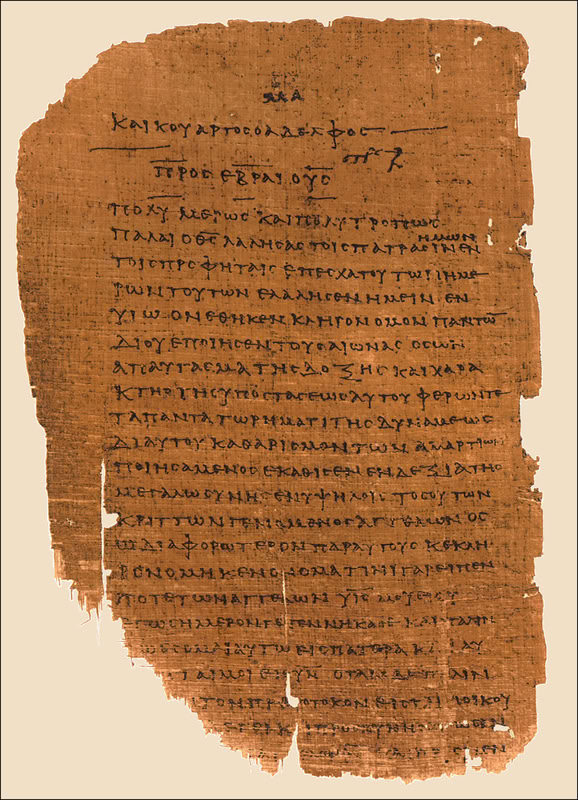
Photo Credit: Early Bible
I was actually working on several another projects while working off and on on this one. One of the others happened to be a study of surviving ancient bible manuscripts when I ran across Papyrus 46 (often abbreviated as “P46”) by accident and finally realized its significance to this article. In fact, I believe that surviving ancient manuscripts are some of the strongest arguments in favor of Pauline authorship. In most of the earliest surviving papyrus manuscripts, such as Papyrus 46, that is dated about 200 AD, we find Hebrews located directly after Romans, and thus bundled with Paul’s other letters.
Digging further, we discover that, not only in the case of P46, but in all other known early manuscripts containing portions of Hebrews, it circulated with the other writings of Paul. In fact, there appears to be no surviving evidence in which a significant portion of Hebrews was circulated on its own.
P46 dates back to the early-to-mid second century (~100-150 AD), which would date the writings within roughly 35-80 years after the martyrdom of Paul. Thus many second and third generation Christians were already familiar with his circulating writings. The vast majority of surviving manuscripts are merely fragments. What makes P46 so special is that, it preserves large portions of Romans, 1 and 2 Corinthians, Galatians, Ephesians, Philippians, Colossians, and 1 Thessalonians. With respect to the Hebrews papyrus it is located right after Romans and just before 1Corinthians in P46. In the modern NT, Paul’s epistles are generally arranged by length. Since Hebrews was initially disputed, it was eventually moved to the front of the General Epistles.
To summarize, I believe the theology is decidedly Pauline, however some of the terminology is unique, or at least varies somewhat from Paul’s undisputed works. I believe that
Origen’s words about the author still ring true today: “God only knows.”